
Fence Installation Cost: What You'll Pay by Material and Length
Wood, vinyl, chain link, or aluminum — here's what a new fence really costs per linear foot, where the money goes, and how to avoid the classic surprises.
10 min read · Home Services Pro USA
Quick answer
Most U.S. homeowners spend $1,800 to $4,800 to install a standard backyard fence, with a national midpoint near $3,100 for roughly 150 linear feet. Installed pricing typically runs $15 to $45 per linear foot depending on material: chain link is cheapest at $12 to $25 per foot, wood privacy fencing runs $20 to $40, vinyl runs $25 to $50, and ornamental aluminum runs $30 to $60. Labor is usually 40 to 60 percent of the total.
Key Takeaways
- Chain link: $12–$25 per linear foot installed. Wood privacy: $20–$40. Vinyl: $25–$50. Aluminum: $30–$60.
- A typical 150-foot backyard fence lands between $1,800 and $4,800 for most materials.
- Gates, sloped terrain, rock or tree roots, and old fence removal are the four most common budget surprises.
- A property survey and utility locate (call 811) should happen before any post hole is dug.
- Labor is 40 to 60 percent of the total — this is why material upgrades often cost less than homeowners expect.
Fence Installation Cost by Material
Fencing is priced by the linear foot, and material choice is the single biggest cost lever. The same 150-foot perimeter can cost $1,800 in chain link or $7,500 in ornamental aluminum, so it pays to decide what the fence is actually for — privacy, pets, pool code, or curb appeal — before comparing prices.
Chain link remains the budget workhorse at $12 to $25 per linear foot installed. It is durable, fast to install, and ideal for containing dogs, but it adds little privacy or visual appeal. Privacy slats and vinyl coatings push the price toward the top of that range.
Wood privacy fencing is the most popular choice in American backyards, running $20 to $40 per foot installed. Pressure-treated pine sits at the low end; cedar and redwood cost more but resist rot and insects better. Expect to stain or seal a wood fence every two to three years, which is a real ownership cost worth factoring in.
Vinyl (PVC) fencing runs $25 to $50 per foot installed. The upfront premium over wood buys you a fence that never needs painting and won't rot, warp, or host termites. Quality varies widely — cheap vinyl turns brittle and chalky, so ask about wall thickness and UV inhibitors.
Ornamental aluminum and steel run $30 to $60 per foot installed. These are the standard choice for pool enclosures and front yards where you want security without blocking sightlines. True wrought iron is a premium custom product and can exceed $75 per foot.
| Material | Cost per linear foot | 150-ft total | Lifespan |
|---|---|---|---|
| Chain link | $12 – $25 | $1,800 – $3,750 | 20 – 30 years |
| Wood privacy (pine) | $20 – $35 | $3,000 – $5,250 | 15 – 20 years |
| Wood privacy (cedar) | $25 – $40 | $3,750 – $6,000 | 20 – 25 years |
| Vinyl (PVC) | $25 – $50 | $3,750 – $7,500 | 25 – 30+ years |
| Ornamental aluminum | $30 – $60 | $4,500 – $9,000 | 30+ years |
| Composite | $35 – $65 | $5,250 – $9,750 | 25 – 30 years |
Where the Money Actually Goes
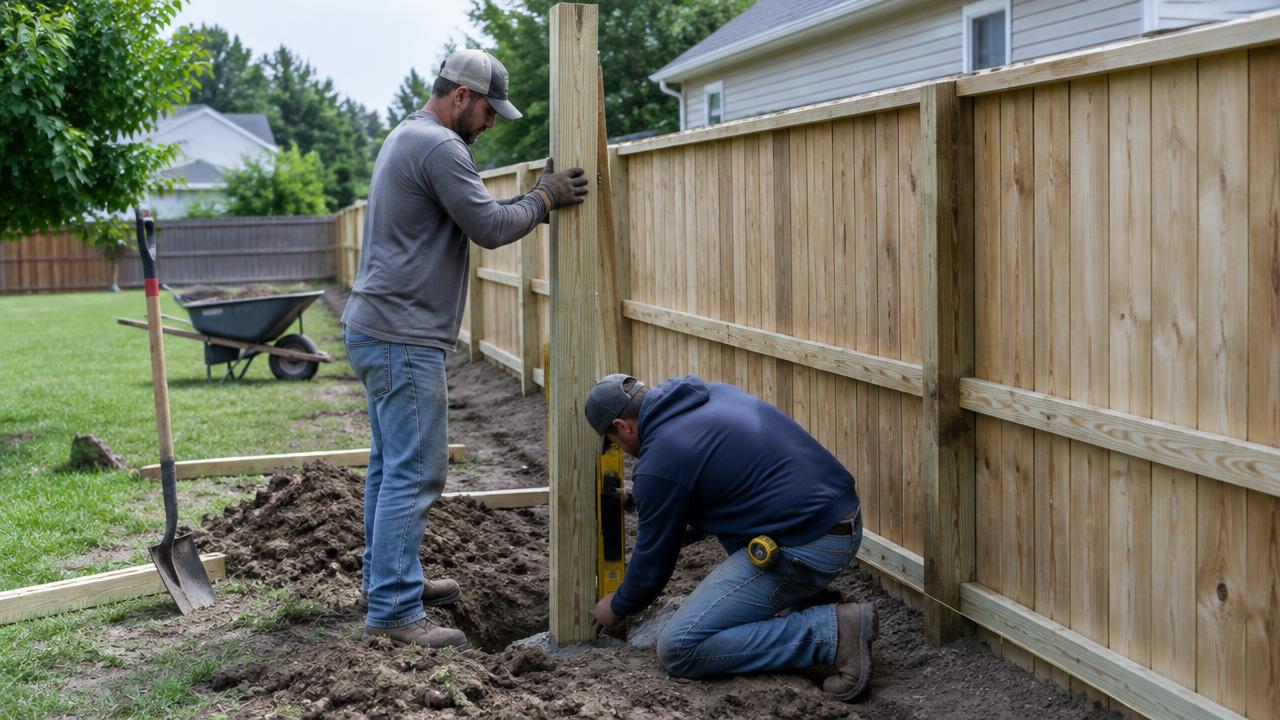
Materials get the attention, but labor is 40 to 60 percent of most fence invoices. Setting posts is the labor-dense part: each post hole is dug below the frost line (anywhere from 12 inches in the South to 48 inches in the upper Midwest), the post is leveled and braced, and concrete is poured. A 150-foot fence has roughly 20 posts, and each one has to be right.
Terrain changes everything. A flat, clear yard with soft soil is the pricing baseline. Slopes require stepped or racked panels, which slows installation. Rocky soil, clay, and tree roots can turn a 20-minute auger job into an hour of hand digging per hole. If your yard has any of these, expect a per-foot surcharge or a separate line item.
Old fence removal is rarely included in headline prices. Tear-out and haul-away typically adds $3 to $8 per linear foot, and more if the old posts were set in large concrete footings that have to be broken out.
Gates are priced individually and add up fast. A standard walk gate runs $150 to $400 installed; a double drive gate runs $400 to $1,200 or more depending on width and hardware. Count your gates before you compare bids — two quotes with different gate counts are not comparable.
- Labor: 40–60% of total project cost
- Fence materials (panels, posts, rails): 30–45%
- Concrete and hardware: 5–10%
- Gates: $150 – $1,200 each, depending on size
- Old fence removal: $3 – $8 per linear foot
Permits, Surveys, and Property Lines
Most municipalities require a permit for fences over a certain height — commonly six feet — and many regulate front-yard fence height, style, and setback. Permit fees are usually modest ($20 to $150), but skipping a required permit can mean tearing out a finished fence. A reputable installer will tell you what your town requires; many handle the permit for you.
Property lines are where fence projects go wrong. Building six inches onto a neighbor's lot can legally require you to move the fence at your own expense. If your pins can't be located or there's any doubt, a boundary survey ($300 to $800) is cheap insurance. If you're sharing a boundary, talk to the neighbor first — many will split the cost of a fence they'll also enjoy.
Before any digging, the installer should call 811 to have underground utilities marked. Hitting a gas, electric, or fiber line is dangerous and expensive, and the locate service is free.
How to Compare Fence Installation Quotes
Fence quotes should specify the linear footage, the exact material (not just 'cedar' but the grade and board dimensions), post size and spacing, post depth and concrete, the number and size of gates, hardware quality, and whether tear-out and haul-away are included. A quote that just says '150 ft privacy fence — $4,200' tells you almost nothing.
Ask how posts are set. Posts set in concrete below the frost line outlast posts set in gravel or driven into the ground, and this single detail explains many price gaps between bids. Also ask about the warranty on both materials and workmanship — one year on labor is a common baseline; five years is a sign of a confident installer.
Get three written quotes with identical specs and compare them line by line using our guide on how to compare home improvement estimates. When you're ready, you can get matched with local fence contractors and request free estimates through Home Services Pro USA.
Frequently Asked Questions
- How much does it cost to install a 150-foot fence?
- A 150-linear-foot fence typically costs $1,800 to $7,500 installed, depending on material. Chain link lands at $1,800–$3,750, wood privacy at $3,000–$6,000, vinyl at $3,750–$7,500, and ornamental aluminum at $4,500–$9,000. Gates, slopes, and old fence removal add to these figures.
- What is the cheapest fence to install?
- Chain link is the cheapest fence to install at $12 to $25 per linear foot. For privacy on a budget, pressure-treated pine is the most affordable solid fence at $20 to $35 per foot, though it requires staining or sealing every few years.
- Does a new fence increase home value?
- A well-built fence typically recovers 50 to 70 percent of its cost at resale, and it can meaningfully improve marketability for buyers with dogs or young children. Privacy fences in family neighborhoods and code-compliant pool fences tend to return the most.
- Do I need a permit to build a fence?
- In most U.S. municipalities, yes — especially for fences over six feet tall or in front yards. Permit fees usually run $20 to $150. Many installers handle the permit as part of the job; ask before signing.