
Gutter Installation Cost: Materials, Sizes, and What to Expect
Seamless aluminum, copper, sizing, guards, and downspout placement — a complete guide to pricing and specifying a gutter installation.
8 min read · Home Services Pro USA
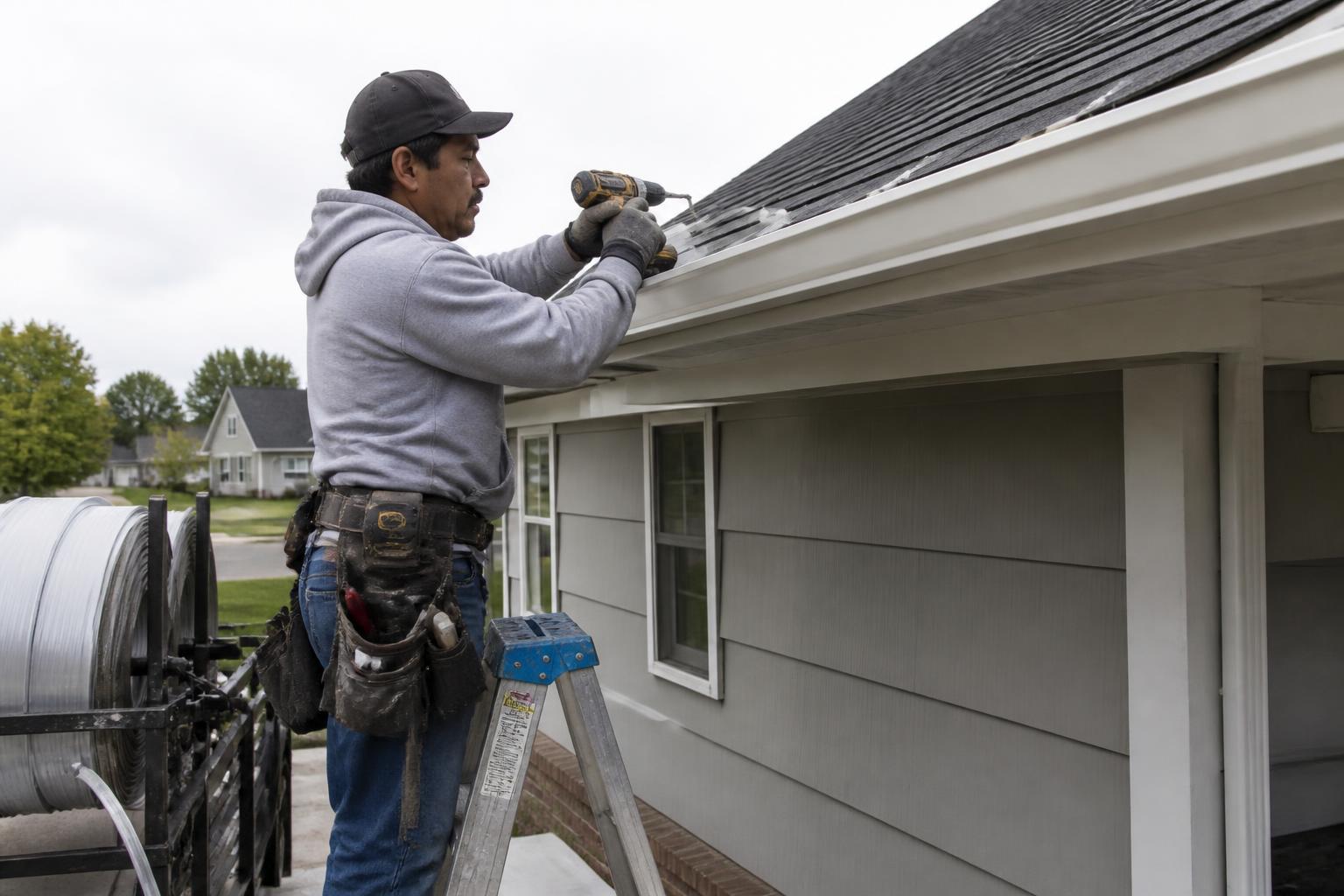
Quick answer
Gutter installation typically costs $8 to $25 per linear foot installed, putting a full replacement on an average home at roughly $1,500 to $4,500. Seamless aluminum is the mainstream choice at $8 to $16 per foot; copper runs $25 to $50 per foot. Fascia repair, gutter guards, and extra downspouts are the most common add-ons.
Key Takeaways
- Most homes need 150 to 250 linear feet of gutter.
- Seamless aluminum offers the best balance of cost and durability for most homeowners.
- Upgrade to 6-inch K-style gutters on steep or large roofs in heavy-rain regions.
- Downspout placement and drainage away from the foundation matter more than the gutter itself.
What Gutters Cost by Material
Gutters are quoted per linear foot installed. Most single-family homes need somewhere between 150 and 250 feet depending on roofline complexity, so material choice compounds quickly across the whole house.
Seamless aluminum dominates the market for good reason: it is formed on site from a coil so there are no joints to leak except at corners and outlets, it does not rust, it comes in dozens of baked-on colors, and it is affordable. Vinyl is cheaper but becomes brittle in cold climates and sags between hangers under snow load. Galvanized steel is strong but eventually rusts. Copper is beautiful, lasts generations, develops a patina, and costs several times as much.
| Material | Cost per linear foot | Typical lifespan |
|---|---|---|
| Vinyl | $4 – $9 | 10 – 15 years |
| Seamless aluminum | $8 – $16 | 20 – 30 years |
| Galvanized steel | $10 – $20 | 20 – 25 years |
| Zinc | $20 – $40 | 50+ years |
| Copper | $25 – $50 | 50 – 100 years |
Sizing: 5-Inch vs 6-Inch and Why It Matters
Five-inch K-style gutter is the residential default and handles the runoff of most moderate roofs. Six-inch K-style carries roughly 40 percent more water and is the right call for large roof planes, steep pitches that accelerate runoff, and regions with intense downpours.
Sizing is a drainage calculation, not a style preference. It depends on the roof area draining into each run, the pitch, and the local maximum rainfall intensity. When gutters overflow in heavy rain despite being clean, undersizing or too few downspouts is usually the reason — not the gutter itself failing.
Downspouts follow the same logic. A 2x3-inch downspout handles far less water than a 3x4-inch. On most homes, one downspout every 30 to 40 feet of gutter run is a reasonable minimum, more on large or steep roofs.
- 5-inch K-style: standard for most moderate roofs
- 6-inch K-style: large, steep, or heavy-rainfall roofs
- Half-round: traditional and architectural homes, often paired with copper
- 3x4-inch downspouts move significantly more water than 2x3-inch
Gutter Guards: Worth It or Not?
Gutter guards add roughly $5 to $20 per linear foot depending on type, which can nearly double the project cost. Whether that is worthwhile depends almost entirely on your trees.
On a lot with mature oaks or pines dropping needles and catkins, a quality micro-mesh guard can turn a twice-yearly ladder chore into an occasional rinse. On a lot with no overhanging trees, guards mostly solve a problem you do not have.
Be skeptical of "never clean your gutters again" claims. Every guard type still accumulates fine debris and shingle grit on top, and micro-mesh needs periodic brushing. Reverse-curve guards can overshoot in heavy rain on steep roofs. Foam inserts are inexpensive and generally the weakest performer over time.
Fascia, Pitch, and Installation Quality
The gutter is only as sound as the fascia board it hangs from. Years of overflowing or leaking gutters routinely rot the fascia underneath, and that rot is often invisible until the old gutter comes down. A good contractor inspects the fascia during the estimate and quotes a per-foot price for replacement so the discovery does not become an argument.
Pitch matters more than most homeowners realize. Gutters need roughly a quarter inch of slope per 10 feet toward the downspout. Too little and water stands, breeding mosquitoes and accelerating corrosion; too much and it looks wrong from the curb. Hidden hangers screwed into solid framing every 24 to 36 inches keep the run from sagging.
Finally, where the water goes after the downspout is the part that protects your home. Discharging at the foundation is a leading contributor to basement seepage and settlement. Extensions, splash blocks, or buried drain lines should carry water at least four to six feet away and downhill.
If foundation moisture is already a concern, our basement remodeling and concrete categories cover the professionals who address it.
Repair, Reseal, or Replace
Isolated problems — a loose hanger, a leaking corner miter, a detached downspout — are inexpensive repairs, often a few hundred dollars. Resealing seams on a sectional system buys time but is a recurring chore.
Replacement makes sense when you see sagging between hangers, separated seams across multiple runs, rust-through, peeling paint on the fascia and siding below the gutter line, or persistent overflow that cleaning does not fix.
Gutter replacement also pairs naturally with a roof replacement. The crew is already staged, drip edge and gutter apron can be integrated properly, and you avoid paying twice for access. If a new roof is on your horizon, read our roof replacement cost guide and get both quoted together.
Seasonal Maintenance That Prevents Expensive Damage
Gutters are the cheapest water management system your home has, and neglecting them is one of the most reliable ways to create four- and five-figure repair bills. Standing water in a clogged run adds significant weight, pulls hangers loose, rots fascia, and backs up under the roof edge where it can reach the decking and the interior wall assembly.
In freezing climates the failure mode is ice damming. Warm air escaping into the attic melts snow on the upper roof; the water refreezes at the cold eave and behind a clogged gutter, then backs up under the shingles. The real fix is attic insulation and balanced ventilation, but clean gutters and properly installed ice-and-water shield at the eaves are essential parts of the defense.
A practical maintenance rhythm for most homes is two cleanings a year — late spring after seed drop and late fall after leaves come down — plus a check after any major storm. While you are up there, look at the fascia and soffit for staining, confirm hangers are tight, and make sure downspout extensions have not been kicked out of place by a mower or a delivery.
Watch the ground too. Erosion trenches under the eaves, mulch washed away from a bed, or a persistent damp patch at the foundation all indicate that water is landing where it should not. Left alone, that pattern is a leading contributor to basement seepage, foundation settlement, and cracked walkways — repairs that cost many times what the gutter work would have.
If your gutters are more than fifteen years old and you are already dealing with recurring clogs, sag, and separated seams, the maintenance math often favors replacement with correctly sized seamless runs and enough downspouts to handle real rainfall rather than repeatedly servicing a system that was undersized from the start.
How to Compare Gutter Quotes
Ask each contractor for total linear footage, gutter size and profile, material gauge (0.027-inch aluminum is builder grade; 0.032-inch is noticeably more rigid), hanger type and spacing, number and size of downspouts, color, and whether fascia repair and old gutter disposal are included.
Confirm that the quote addresses drainage away from the foundation and specifies who handles any buried line connections. Ask whether the installer is an employee or a subcontractor, and what the workmanship warranty covers.
Gutter work is a small enough project that homeowners often skip due diligence — but it involves ladders, fascia carpentry, and water management against your foundation. Licensing and insurance verification still matter.
When you are ready, describe the job once on Home Services Pro USA and we will match you with local pros, or browse roofing, siding, and the full list of home service categories.
Frequently Asked Questions
- How much does it cost to install gutters on a house?
- Most homeowners pay $1,500 to $4,500 for full gutter replacement, based on $8 to $25 per linear foot installed and 150 to 250 feet of gutter on a typical single-family home.
- Are seamless gutters worth the extra cost?
- Yes for most homes. Seamless aluminum eliminates the joints where sectional gutters most often leak, costs only modestly more, and typically lasts 20 to 30 years.
- Should I get 5-inch or 6-inch gutters?
- Five-inch K-style handles most moderate roofs. Choose 6-inch for large roof areas, steep pitches, or regions with heavy downpours, since it carries roughly 40 percent more water.
- Do gutter guards really work?
- Quality micro-mesh guards significantly reduce cleaning frequency under heavy tree cover, but no guard eliminates maintenance entirely. On lots without overhanging trees, the payback is limited.
- How long does gutter installation take?
- A typical single-family home is completed in one day. Fascia repair, multiple stories, or complex rooflines can extend the job to two days.