
Heat Pump vs. Tankless Water Heater: Which Fits Your Home?
Compare installation requirements, hot-water capacity, energy use, and local quote details before replacing your water heater.
10 min read · Home Services Pro USA
Quick answer
Choose a heat pump water heater when reducing electricity use is a priority and your home has suitable space, airflow, drainage, and electrical service. Consider tankless when saving floor space or serving sustained hot-water demand matters most, provided the unit can meet your simultaneous flow and temperature-rise needs. Compare installed quotes and local energy rates—not equipment prices alone. Neither system is best for every home.
Key Takeaways
- A hybrid heat pump water heater stores hot water; tankless heats it as water flows through the unit.
- Compare a storage model’s first-hour rating with peak demand, and tankless output with simultaneous flow at the required temperature rise.
- Gas tankless and electric tankless are different installations; do not treat their utility requirements as interchangeable.
- Airflow, condensate drainage, venting, and electrical or gas upgrades can change the full project cost.
- Request an inspection-based local estimate and verify any incentive before including it in your budget.
Heat Pump vs. Tankless: Start With the Problem You Want to Solve
Replacing a water heater is an opportunity to solve a specific household problem: high electricity use, a crowded utility room, unreliable hot water, or an aging appliance. Start by identifying that problem rather than choosing whichever technology sounds newest. A system that works well in a spacious basement may be a poor fit for a small enclosed closet. A compact unit can still need substantial work behind the wall.
This comparison focuses on residential hybrid heat pump water heaters and gas or electric tankless units. It complements our broader water heater replacement cost guide, rather than replacing an inspection or a model-specific installation manual. The best next step is to identify which options your property can support, then compare the installed cost of those feasible options.
How Does a Hybrid Heat Pump Water Heater Work?
An integrated heat pump water heater uses electricity to transfer heat from surrounding air into water stored in a tank. Most models also include electric resistance elements for backup, which is why they are often called hybrid water heaters. ENERGY STAR explains this design in its technical guide; moving heat is different from generating all the heat directly with resistance elements. 1
The storage tank supplies ready hot water, while the system replenishes it over time. That means tank size, recovery, and operating mode matter. Ask the installer how the proposed unit handles your busiest period and when backup heating would run. An efficiency claim does not by itself establish that a particular model will keep up with your morning routine.
The installation location is part of the system design. The Department of Energy’s decision-guidance module specifically identifies room temperature, clearance, electrical connections, plumbing, and condensate drainage as considerations. Ask for an explanation of each at your actual installation site, including any proposed ducting or relocation. Do not assume the space that held your old tank automatically suits a hybrid model. 2
How Does a Tankless Water Heater Work?
A tankless water heater heats water as it passes through the unit, using a gas burner or electric heating elements rather than a large stored reserve. Manufacturer A. O. Smith describes continuous hot-water delivery when the equipment is appropriately sized. That condition is important: continuous does not mean unlimited flow for every fixture at once. 3
Ask whether the proposal is gas or electric tankless. For gas, discuss fuel supply, venting, and any condensate requirements for the selected model. For electric, have the required electrical service evaluated before treating the installation as a straightforward swap. The fact that an appliance fits on a wall does not establish that your existing utilities can support it.
Also distinguish hot-water capacity from delivery time. Water still travels through pipes between the heater and the faucet. Ask whether the proposal includes a recirculation arrangement and what that changes about installation, controls, and energy use. If your main complaint is waiting at a distant bathroom, simply choosing tankless may not address the actual problem.
Side-by-Side Comparison: Space, Capacity, and Installation
Use this checklist to frame a site visit, not to select a model without one. The heat pump installation and sizing considerations follow DOE guidance, while the operating-design distinction follows A. O. Smith’s comparison. The questions below are our homeowner planning prompts. 2 3
| Decision | Hybrid heat pump | Tankless |
|---|---|---|
| Hot-water supply | Stored volume plus recovery | On-demand output within the unit’s capacity |
| Sizing conversation | Peak demand and first-hour rating | Simultaneous flow and temperature rise |
| Space review | Tank footprint, clearance, and air supply | Mounting location and service access |
| Utility review | Model-specific electrical requirements | Gas supply and venting, or electrical capacity |
| Additional work to ask about | Condensate routing, ducting, or relocation | Venting, utility upgrades, and plumbing changes |
Which Costs Less to Install? Compare the Whole Project
Neither technology has a universal installed price advantage. A quote includes more than the appliance: connections, labor, removal, permits where required, and any changes needed to make the location suitable. A low equipment price can be outweighed by electrical work, venting, or relocation. Ask the bidder to separate the base installation from required upgrades and optional features.
Request two clearly defined scopes when both technologies are feasible. For each, obtain the model number, sizing rationale, installation location, included work, exclusions, and total before incentives. If the contractor cannot inspect the home before quoting, ask which assumptions could change after inspection. That is more useful than applying a national average to a conversion with unknown utility requirements.
Our estimate comparison guide explains how to compare scope before price. For this project, pay special attention to who handles electrical work, whether disposal is included, how permits and inspections are managed, and whether commissioning is documented. A more expensive quote may include work the cheaper one leaves for someone else.
Which Uses Less Energy—and Will Your Bills Fall?
ENERGY STAR identifies substantial energy-use benefits for certified heat pump water heaters compared with standard electric water heaters. That is a comparison with conventional electric resistance equipment, not a promise that every heat pump installation costs less to operate than every gas tankless model. Keep the baseline clear when evaluating advertised savings. 1
For a household cost comparison, gather your local electricity and gas rates, the proposed model’s estimated usage, and your hot-water pattern. Ask which assumptions the estimate uses. A calculation based on a different household size, different operating mode, or another utility territory may not describe your likely bill. Where fuel changes, consider whether any gas service charges would remain because other appliances still use gas.
Treat payback as a scenario rather than a guaranteed result. Compare the additional installed cost with a documented estimate of annual operating savings, and ask how maintenance affects the result. If a salesperson promises a precise payback period but cannot explain the rates or usage assumptions, request the calculation before making it part of your decision.
How to Size Each System for Your Household
For a heat pump storage model, describe the busiest hot-water period: consecutive showers, laundry, dishwashing, and any other relevant use. DOE’s decision guidance specifically connects household demand with tank size and first-hour rating. Do not choose solely by matching the gallon capacity printed on the old appliance. Ask how the new model’s recovery and operating modes affect that peak period. 2
For tankless, give the installer a list of fixtures that might run together. Ask for the model’s output at the temperature rise needed at your home, not just its most favorable advertised flow rate. A. O. Smith’s comparison explains that tankless capacity must be appropriate to demand. The practical question is whether the proposed unit can maintain useful delivery during your realistic simultaneous-use scenario. 3
Two illustrative households show why the label alone is insufficient. A family with back-to-back morning showers should ask how storage and recovery cover that sequence. A household running multiple fixtures at the same time should ask how tankless output covers the combined demand. These are planning examples, not measured performance results or recommendations for a specific tank size.
Local Climate and Installation Space Can Change the Answer
Compare the room’s conditions, not just the state’s weather. A conditioned basement in a cold region and an exposed garage in the same region are different installation environments. DOE guidance flags location constraints and room temperature for heat pump selection. Ask your installer to check the proposed location against the selected model’s documented requirements. 2
For tankless, ask how local incoming-water conditions affect the capacity calculation and how an outdoor installation, if proposed, would be protected under the manufacturer’s requirements. For either technology, obtain local permit guidance and confirm whether an association approval is needed. A statewide service description cannot establish the rules for your particular address.
Our service-area directory can help you start with the relevant market, but the actual installation decision belongs in a property-specific assessment. Ask about delivery access, stairs, working clearances, and future service access. Saving visible floor space is less valuable if the final location makes routine maintenance difficult.
Maintenance, Warranties, and Rebates: Questions Before You Sign
Request the maintenance schedule for the exact model. Ask which tasks are expected of the homeowner, which require professional service, and whether local water conditions change the recommendations. For tankless, discuss any manufacturer-required descaling procedure; for heat pump, ask about air-path maintenance and condensate checks. Follow the manual rather than assuming one schedule applies to every installation.
Separate the manufacturer’s equipment warranty from the installer’s workmanship warranty. Ask whether labor, diagnostic visits, or replacement parts are covered, who handles a claim, and whether registration or maintenance documentation is required. Keep the model number, installation invoice, commissioning information, and warranty documents together for future service.
Do not subtract an advertised rebate or tax benefit until eligibility is verified with the current program administrator. Programs, qualifying models, funding, application deadlines, and tax rules can change. Ask whether preapproval is necessary and whether the quoted amount is available to your household. This guide does not promise a federal tax credit or a particular state or utility rebate.
A Practical Decision Checklist Before Requesting Local Quotes
Choose a shortlist after the feasibility review. A heat pump model merits consideration when you want to reduce electricity use and can provide a suitable installation environment. Tankless merits consideration when compact placement or sustained delivery is important and the home can support the required utilities. Keeping a conventional replacement on the comparison list may also be sensible if conversion work conflicts with your budget or timeline.
Before booking an assessment, gather safe-to-access photos of the existing appliance, its label, and the surrounding space. Describe your hot-water complaints and preferred timing. Do not open electrical equipment, alter gas piping, or attempt vent changes to prepare for a quote. If you suspect a gas leak or another immediate hazard, contact the utility or appropriate emergency service instead of waiting for a routine referral.
When ready, explore our water heater services or request a project match. Home Services Pro USA is a referral platform, not the installer. Availability varies by location and project. You decide whether to request an estimate or hire, and should independently verify credentials, insurance, scope, and contract terms before proceeding.
- Write down the problem you want the replacement to solve.
- Ask for a site-specific sizing explanation and model number.
- Compare complete installed scopes before comparing totals.
- Verify permits, maintenance, warranties, and any incentive separately.
- Choose based on documented fit—not a universal claim that one technology wins.
Sources and Editorial Notes
Published November 28, 2026. Technical references include ENERGY STAR’s Heat Pump Water Heater Guide, which identifies its guidance as current as of June 2024; DOE Building Science Education’s heat pump decision module; and A. O. Smith’s technology comparison. The manufacturer source explains operating design and is not an independent price survey. Links appear alongside the claims they support.
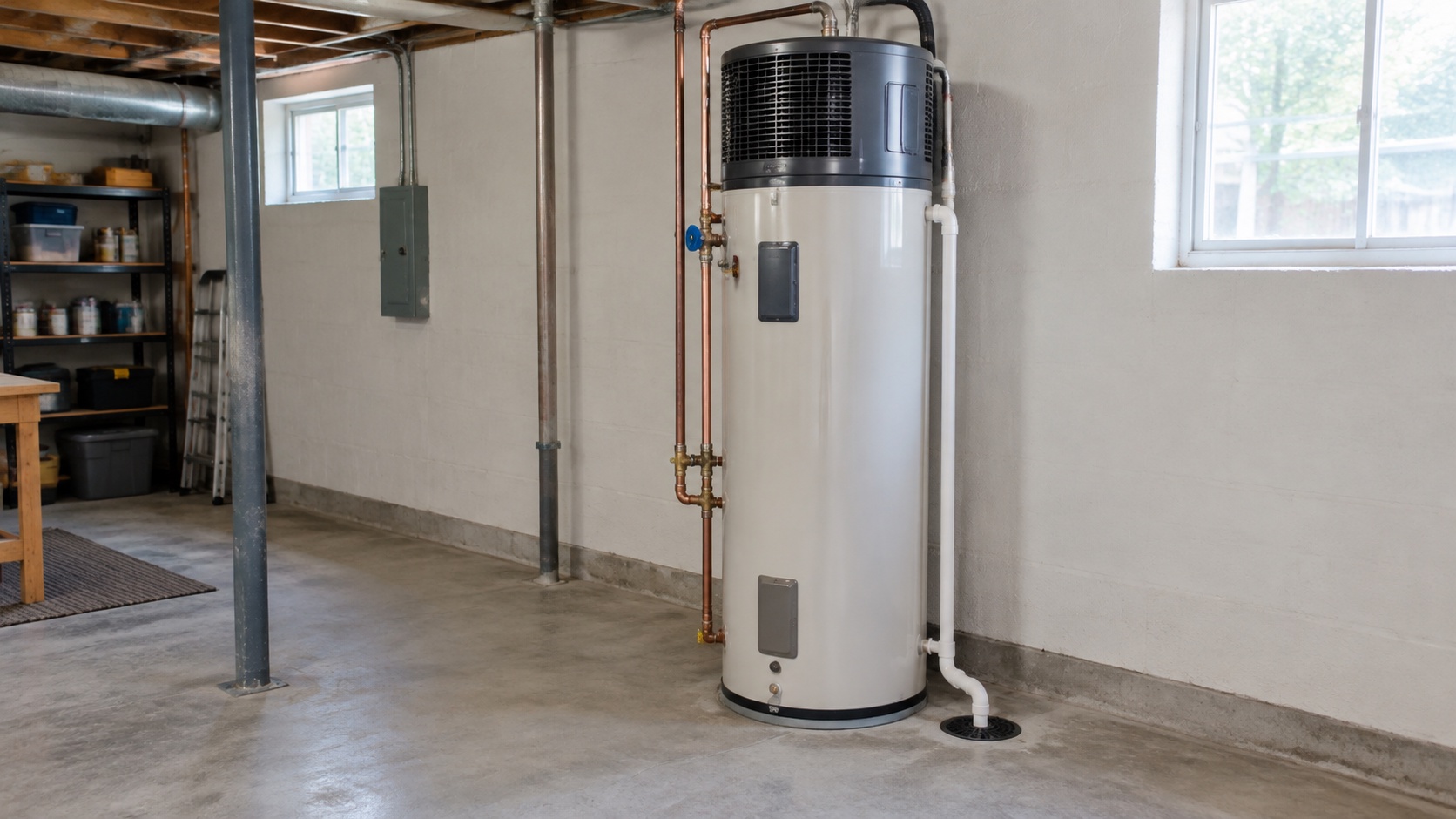
The quote checklist and household scenarios are Home Services Pro USA’s editorial planning guidance, not results from our own installation study. We have not claimed local prices, guaranteed savings, or a universal payback period. The accompanying image is an AI-generated illustration of a residential heat pump installation, not a customer project, installation diagram, or endorsement of any equipment brand.
Frequently Asked Questions
- Is a heat pump water heater better than tankless?
- Not in every home. A heat pump model can suit an electricity-efficiency goal when space, airflow, drainage, and electrical service are appropriate. Tankless can suit compact placement or sustained demand when it is correctly sized and the home supports its utility requirements.
- Is a hybrid water heater the same as a heat pump water heater?
- In this guide, hybrid means an integrated heat pump water heater with electric resistance backup elements. Check the model specifications because a product name alone does not explain its operating modes or installation requirements.
- Does tankless provide unlimited hot water?
- It can provide continuous hot water within its capacity. Simultaneous fixture use and the required temperature rise still limit the flow it can supply. Ask for a sizing calculation for your household.
- Can I put a heat pump water heater in my existing closet?
- Only if the selected model’s space, airflow, clearance, temperature, drainage, and electrical requirements can be met. Have the installer evaluate the closet rather than assuming it is suitable because a conventional tank was there.
- Which is cheaper to install, heat pump or tankless?
- The answer depends on equipment and the work your home needs. Compare inspection-based installed quotes covering connections, required upgrades, removal, permits where applicable, and commissioning—not appliance prices alone.
- Are rebates or tax credits guaranteed for a heat pump water heater?
- No. Verify current eligibility, qualifying equipment, funding, deadlines, and any preapproval requirements with the relevant program administrator before counting an incentive in your budget.